
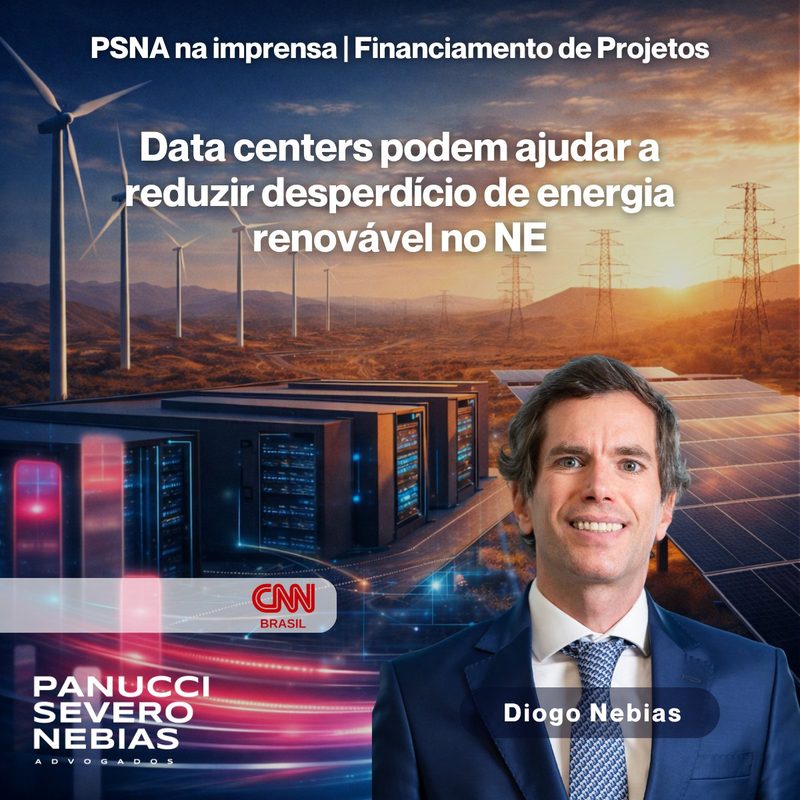

Our Partner Diogo Nebias published an article on CNN Brasil about the impact of data centers on the Brazilian electric power system.
The announcement of investments in the Northeast, such as the project associated with TikTok in Pernambuco, draws attention not only for its technological and economic impact, but for its direct effect on energy dynamics in Brazil.
The country has rapidly expanded its renewable generation capacity, especially wind and solar. The problem is that a significant portion of this energy is currently not consumed, due to transmission and demand limitations.
This is where data centers come in. These facilities function as anchor consumers, capable of:
- creating local demand for energy that would otherwise be wasted;
- reducing system constraints; and
- stabilizing the relationship between supply and consumption.
But the central point is not energy. It is financial. By introducing predictable, long-term demand, data centers make it possible to structure:
- robust energy supply agreements;
- self-generation models; and
- most importantly, viable project finance transactions.
This changes the equation for these projects. What was once surplus becomes an asset that can be contracted, financed and scaled.
Projects of this nature require integrated structuring of energy, contracts, financing, guarantees and licensing, with efficient allocation of risks among the parties involved.
Data centers, in this context, are not merely digital infrastructure: they are platforms that enable investment in energy and infrastructure.
It is at this intersection of energy, technology and capital that projects actually happen.


