
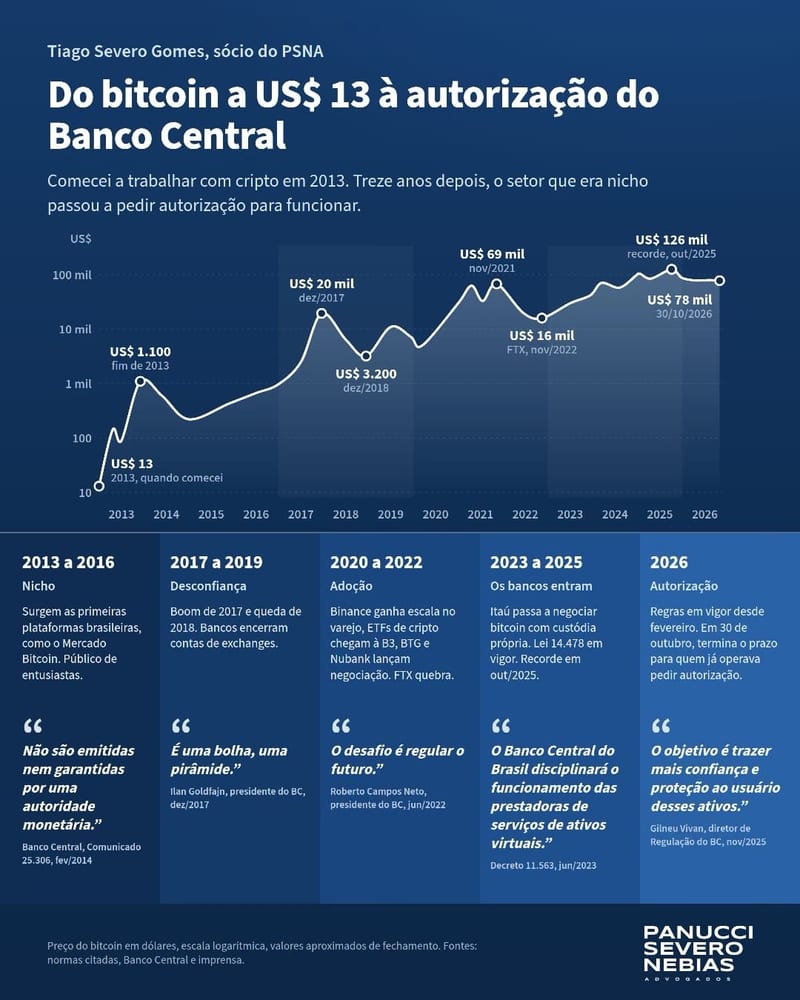

On October 30, the deadline expired for crypto asset exchanges and other virtual asset service providers already in operation to apply for authorization from the Central Bank. For Partner Tiago Severo Gomes, who began working with crypto in 2013, when one bitcoin was worth US$ 13, the date closes a cycle of more than a decade.
During this period, the sector went through very different phases. The statements of the authorities themselves show how the tone changed in each one.
The five phases
- Niche (2013 to 2016). The first Brazilian platforms emerge, and the audience is still made up of enthusiasts. In 2014, the Central Bank warned that virtual currencies "are neither issued nor guaranteed by a monetary authority." There were no rules and no designated regulator.
- Distrust (2017 to 2019). With bitcoin near US$ 20,000, the then president of the Central Bank, Ilan Goldfajn, summed it up in December 2017: "It is a bubble, a pyramid." Banks were closing exchanges' accounts. In 2019, IN RFB 1.888 defined in a regulation what a crypto asset exchange was and began requiring that transactions be reported to the Federal Revenue Service.
- Adoption (2020 to 2022). Global platforms gain scale in the retail market, crypto ETFs arrive on B3, and institutions such as BTG and Nubank launch trading. In 2022, the year of the Legal Framework (Law 14.478), Roberto Campos Neto was already speaking in a different tone: "The challenge is to regulate the future."
- The banks come in (2023 to 2025). Decree 11.563 provided that "the Central Bank of Brazil will regulate the operation of virtual asset service providers." Large banks began offering crypto. In November 2025, BCB Resolutions 519, 520 and 521 created the virtual asset service provider company (SPSAV).
- Authorization (2026). The rules entered into force in February. In announcing them, the Central Bank's Director of Regulation, Gilneu Vivan, stated: "The goal is to bring more confidence and protection to users of these assets."
What comes next
Tiago followed much of this path from the inside, at ABcripto, as legal advisor and later as director of legal, compliance and self-regulation. In recent months, PSNA has handled the authorization filings of its clients. Along the way, many companies gave up once the cost in capital, governance and the expense of maintaining a supervised institution became clear.
Filing does not end the process. The Central Bank is now reviewing the applications, and the next phase will separate those who filed from those who can permanently sustain the required structure.


