
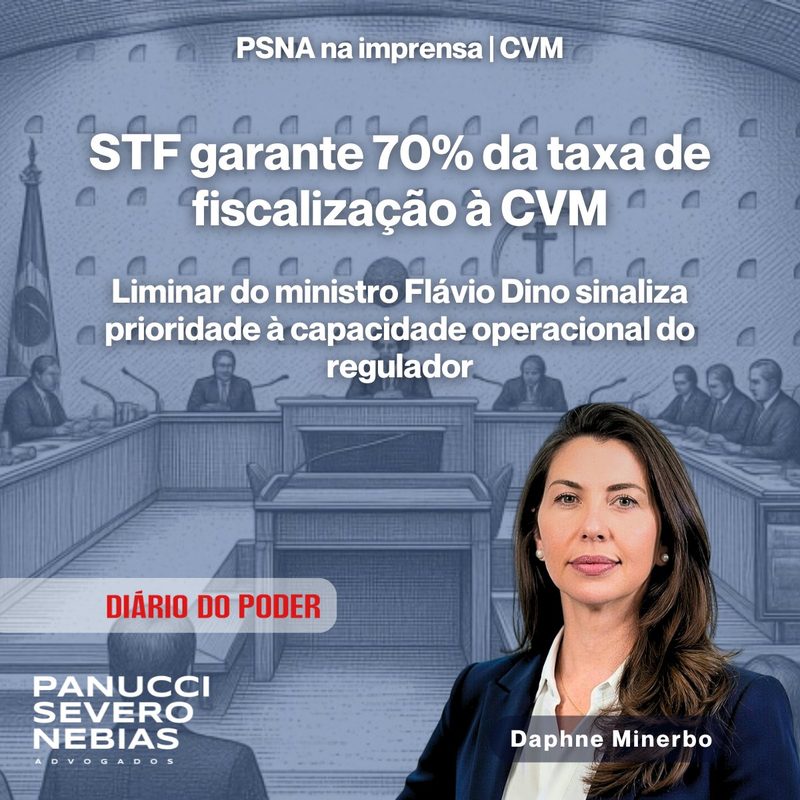

Our Partner Daphne Minerbo was featured in an article in Diário do Poder on the preliminary injunction issued by Justice Flávio Dino of the STF, which requires that at least 70% of the revenue from the oversight fee be allocated to the CVM itself.
In her analysis, Daphne emphasizes that the decision goes beyond the budgetary dimension and directly affects the operational capacity to supervise the Brazilian capital markets, a reading that is consistent with a broader diagnosis: Brazil's regulatory challenge today is, to a large extent, one of enforcement, not of rules.
The measure corrects a long-standing structural distortion. For more than a decade, the fee charged to the market to fund its own supervision had been systematically appropriated by the National Treasury through the Desvinculação das Receitas da União (DRU). The result, in the Justice's own words, was a state of "institutional atrophy and budgetary asphyxia," out of proportion to the size and complexity of the regulated market. The Banco Master case, expressly referenced in the decision, is merely the most visible face of this problem.
Three points seem central to us
- The injunction restores the purpose-based link between sector-specific revenue and regulatory capacity, a principle that underpins the funding rationale of supervisory agencies.
- The emergency plan ordered by the decision, including rebuilding the technical staff, technological solutions and swift enforcement action, aligns with the agenda that regulators abroad have already internalized as a condition for effective supervision in modern markets.
- The CVM case exposes a pattern that is repeated in other Brazilian agencies. The debate over the funding of sector regulation and the constitutional limits of the DRU is likely to take center stage in the coming months.
As Daphne concludes, institutional trust in capital markets is critical infrastructure. The STF decision recognizes this and, together with the recent Lei Antifacção, opens a cycle in which the central question of Brazilian regulatory law ceases to be the production of rules and becomes the building of institutional capacity to enforce them.
The full interview is available at Diário do Poder.


